
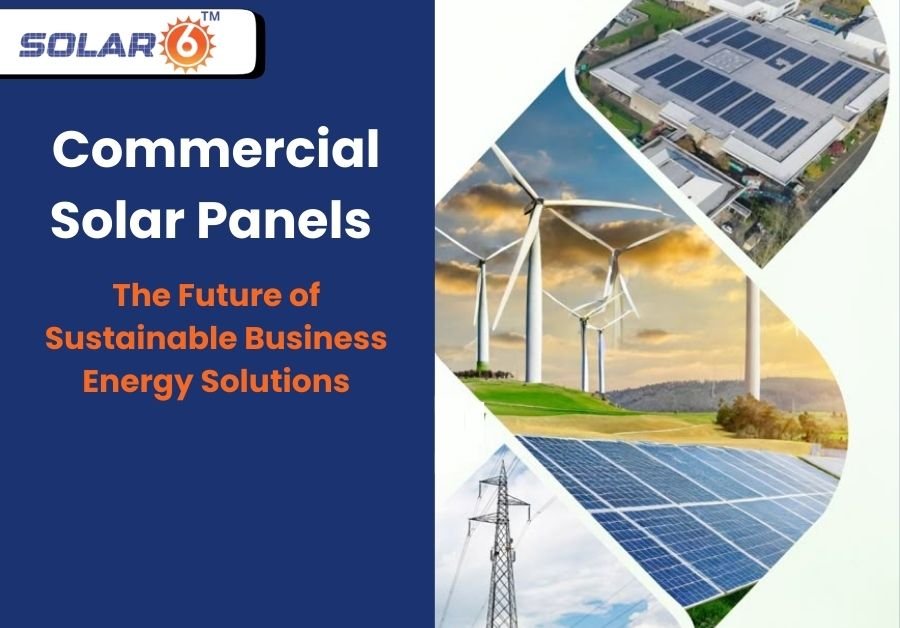
In an era where businesses are striving for cost efficiency and sustainability, commercial solar panels have emerged as a game-changer. Across the world, companies are looking to reduce electricity costs, meet sustainability goals, and achieve energy independence. The adoption of commercial solar power systems is no longer limited to large corporations—small and medium enterprises (SMEs), educational institutions, hospitals, shopping malls, and industrial units are also rapidly shifting toward solar energy for commercial use.
In this article solar6 will provide a comprehensive guide to commercial solar panels, covering benefits, technology, costs, return on investment (ROI), applications, and future trends. By the end, you’ll understand why solar energy systems for businesses are the future of power generation.
What Are Commercial Solar Panels?
Commercial solar panels are high-capacity photovoltaic (PV) modules designed to generate electricity for businesses, factories, and large buildings. Unlike residential solar systems that typically power households, commercial solar power systems are built to handle large-scale energy demands.
- Capacity: Ranges from 10 kW to several MW (megawatts).
- Applications: Rooftops, parking lots, warehouses, ground-mounted solar farms.
- Efficiency: High-performance panels with efficiency levels between 18% and 24%.
- Technology Used: Mono PERC, Polycrystalline, Thin-Film, and Bifacial solar panels.
Why Businesses Are Choosing Commercial Solar Panels
1. Massive Cost Savings
Electricity is one of the biggest operational expenses for businesses. By installing commercial solar energy systems, companies can cut their electricity bills by 50–70%, depending on usage and system size.
2. Quick ROI and Long-Term Savings
While the initial installation cost might seem high, most businesses recover their investment within 3–5 years through savings and government incentives. After that, electricity is practically free for 20–25 years.
3. Government Subsidies and Incentives
Many countries, including India and the U.S., offer tax benefits, subsidies, and net metering policies that make commercial solar highly attractive. For example:
- Accelerated depreciation on solar assets.
- Capital subsidies for rooftop solar projects.
- Net metering to sell excess power to the grid.
4. Sustainability and Green Branding
Consumers and investors increasingly prefer eco-friendly companies. By adopting solar energy for business, organizations can strengthen their brand image, attract sustainability-conscious clients, and meet ESG (Environmental, Social, Governance) goals.
5. Energy Independence
Businesses are no longer dependent on fluctuating grid electricity prices. With solar panels for commercial buildings, companies enjoy stable and predictable energy costs.
Types of Commercial Solar Installations
1. Commercial Rooftop Solar Systems
- Installed on office buildings, schools, colleges, and factories.
- Suitable for companies with large, unused roof space.
2. Ground-Mounted Solar Systems
- Ideal for industries, agricultural businesses, and large facilities with available land.
- Can generate MW-scale power for continuous usage.
3. Carport Solar Systems
- Solar panels are installed on parking lots.
- Provides shade for vehicles while generating electricity.
4. Hybrid Commercial Solar Systems
- Combines solar panels + battery storage.
- Ensures power availability even during grid outages.
Industries Benefiting from Commercial Solar Panels
- Manufacturing Units & Factories – High energy demand, suitable for rooftop or ground-mounted systems.
- Educational Institutions – Schools and universities cut costs while promoting sustainability.
- Healthcare Facilities – Hospitals require uninterrupted power supply, making hybrid solar solutions ideal.
- Retail & Shopping Malls – Reduce operational expenses and improve green branding.
- Hotels & Hospitality – Solar panels reduce bills while supporting eco-tourism.
- Agriculture & Cold Storage – Solar-powered irrigation and storage reduce reliance on costly diesel generators.
How Much Do Commercial Solar Panels Cost?
The cost of commercial solar power systems depends on capacity, technology, and installation type.
- India: ₹40,000 – ₹50,000 per kW (approx.).
System Size Examples:
- 50 kW system = suitable for small factories.
- 100 kW system = ideal for schools, hotels, mid-sized companies.
- 1 MW+ system = suitable for industrial plants, IT parks, or malls.
Tip: Though upfront costs are significant, financing options such as solar loans, power purchase agreements (PPA), and leasing make it accessible for businesses of all sizes.
Return on Investment (ROI)
A typical commercial solar system has a lifespan of 25–30 years. The ROI is impressive:
- Payback Period: 3–5 years.
- Electricity Savings: 50–70% reduction in bills.
- Profitability: Free electricity for 20+ years after payback.
Example:
A factory spending ₹10 lakh per year on electricity can reduce its bill to ₹3–4 lakh after solar installation. Over 25 years, this could mean crores of rupees in savings.
Environmental Impact of Commercial Solar
Switching to solar energy for commercial buildings is not just about saving money—it’s about saving the planet.
- Reduces Carbon Footprint: 1 MW of solar offsets 1,200–1,500 tons of CO₂ annually.
- Saves Fossil Fuels: Less dependency on coal and diesel.
- Promotes Corporate Responsibility: Enhances CSR compliance and environmental commitments.
Challenges in Commercial Solar Adoption
While the benefits are massive, businesses may face certain challenges:
- High Initial Investment – Though financing solutions are available.
- Space Requirements – Large rooftops or open land needed.
- Intermittency – Solar power depends on sunlight; hybrid solutions with storage can help.
- Regulatory Barriers – Approval processes and net metering policies vary by state/country.
Future of Commercial Solar
The future of commercial solar panels looks extremely promising.
- Technology Advancements: Bifacial panels, solar trackers, and AI-driven monitoring.
- Falling Prices: Solar installation costs have dropped by over 70% in the last decade.
- Integration with Storage: Commercial solar + batteries for 24/7 power.
- Corporate Sustainability Goals: More companies committing to 100% renewable energy under RE100 initiatives.
By 2030, analysts predict that solar energy for businesses will dominate the renewable energy sector, making it a standard rather than an exception.
Key Takeaways (KE)
- Commercial solar panels reduce electricity bills by up to 70%.
- Ideal for industries, malls, schools, hospitals, hotels, and agriculture.
- Payback period: 3–5 years, with 20+ years of free electricity.
- Government subsidies and net metering make adoption easier.
- Future-ready businesses are investing in commercial solar today.
Conclusion
Commercial solar panels are not just an energy solution; they are a strategic business investment. From reducing operational costs to strengthening green credentials, solar energy offers a win for businesses and the environment. As technology advances and costs continue to drop, solar energy for commercial use is becoming the backbone of sustainable business growth.
For companies looking to secure long-term savings, achieve sustainability goals, and gain a competitive advantage, there’s no better time than now to go solar.